Sustainability goals set a direction. Whether they make a difference is decided in everyday work. Internal communication can play a significant role in putting those ambitions into practice. To the outside world, sustainability can be loud. In everyday work, it sometimes stays surprisingly quiet: in team conversations, in day-to-day decisions and wherever people start asking what all this actually means for their own work.
It’s worth looking inward, especially in the outdoor industry. We depend on nature and use it in our advertising, and that’s the very relationship we’re willing to be judged on. If you build your business around mountains, rivers and forests, you have a fundamental stake in protecting them. At the same time, the production, transportation and disposal of clothing and equipment leave an environmental footprint.
Much is already in place on paper. Strategies, reports and goals have been around for years. The more interesting question is how sustainability becomes something people do as a matter of course at work.
I wanted to know how internal communication contributes to this in practice, how people see its influence on company culture and what role inner development plays. I explored these questions in my MBA thesis, “Sustainable Inside Out.” I drew on research literature and spoke to seven people working in communication, marketing and sustainability at European outdoor companies, including manufacturers, retailers and material suppliers. The interviews are exploratory and are not representative of the industry, but they offer a look at what happens in practice.
My central argument: Without internal communication, sustainability won’t make it into everyday work, but internal communication alone won’t get it there either. Its impact depends on how it interacts with leadership, structures and personal attitudes. Giving communication strategic attention therefore means designing it as part of that interplay, rather than optimizing individual campaigns and formats in isolation.
Sending a message is one thing. Making a difference is another.
Through internal communication, people reach a shared understanding of what matters in the company and what it means for their work. They coordinate tasks, clarify questions and develop solutions together. In this way, a strategic goal can give people a clear sense of direction in their day-to-day work. That’s where internal communication is at its strongest. It connects the direction a company is taking with the people who will put it into practice.
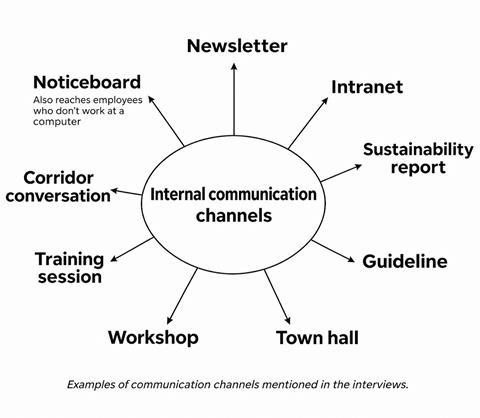
There are plenty of ways to do this, from newsletters, intranets and town halls to workshops, training sessions and hallway conversations. A notice on the bulletin board is another option for employees who don’t work at a computer. The people I interviewed said their main aims were to inform, give people a sense of direction and build understanding. They also wanted to motivate, involve and enable people to act.
But how do you know whether that is working? In some cases, companies track open rates, clicks and interactions. Interviewees relied mostly on observations and informal feedback to judge whether people understood the content and whether it made a difference in their everyday work. That feedback was rarely evaluated systematically. The research literature also points to a frequent focus on quantitative metrics.
I know this from my own work. The newsletter has gone out, and the job seems done. But measuring reach and usage is not the same as capturing impact. An opened email doesn’t tell you whether the product developer, the buyer or the sales associate in the store has understood what the sustainability goal means for their own work. That takes a different set of questions. Where do colleagues see a connection to their decisions? What remains unclear? What do they need in order to take action themselves?
A starting point could be to include a few of these questions in an existing employee survey. First, you need to decide what you want communication to change. Only then can you meaningfully assess what it contributes.
Communication needs a credible environment
What communication can make possible in everyday work also depends on company culture. What is considered important? Which decisions are taken as a matter of course, and which have to be justified? If sustainability is to shape how people think and act every day, it also needs to find its place in the culture.
Internal communication can help. By talking to one another, people come to understand the goals, develop a shared view and question their routines. Can employees ask questions about sustainability, point out conflicting goals and contribute their own ideas? That says something about the culture, and at the same time, this very exchange can change it.
“If you get the feeling that sustainability doesn’t really matter to your manager, at some point you stop pushing for it yourself.”
On this point, everyone I spoke to agreed that internal communication has an important influence on company culture. One person called it the “pivotal point.” However, they described what sustains a culture of sustainability as an interplay of several factors: communication, organizational conditions and how much sustainability matters to employees personally. One interviewee saw spending time together outdoors as helpful in building such a culture. It might sound trite, they acknowledged, but anyone who spends a lot of time in the mountains knows “what a treasure they are” and wants to protect them.
The interviewees put the most emphasis on a fourth factor: how credibly leaders lead by example. You can see what that means in everyday work. Which topics get time and budget? Which suggestions are taken up? What gets followed through on when the next urgent project comes up? Through decisions like these, leaders communicate how much sustainability matters. They’re communicating all the time, even when no one is talking about it. One interviewee described what happens when those signals are missing: “If you get the feeling that sustainability doesn’t really matter to your manager, at some point you stop pushing for it yourself.”
Here’s a thought experiment, separate from the interview findings. A colleague in product development suggests looking into a recycled alternative for a jacket’s main fabric. “Good idea, but we don’t have time for it this time,” her manager replies. That may be justified. If that’s where the conversation ends, it’s easy to get the impression that future suggestions are unlikely to go anywhere. If they agree to look into the idea for the very next collection and actually follow through, the team sees that the suggestion is welcome and has a real chance of going somewhere.
The current schedule is the same in both cases. What changes is how the initiative is dealt with. What happens next is what makes the commitment credible.
That’s why leaders need to be involved in shaping internal sustainability communication. Communication can give people a sense of direction, make participation possible and bring contradictions into the open. Whether that invitation holds up in everyday work also depends on what decisions follow and how much room employees are actually given to act.
Information alone doesn’t equip people to act
A supportive environment opens up possibilities. Whether and how people use them is also up to them. You can see this where communication ends, and a decision begins: when goals clash or when someone puts forward a suggestion or considers it. Taking action at that point takes more than information. If you’ve spent time in the mountains in winter, you’ll be familiar with this. The avalanche bulletin is out, and yet it’s only once you’re out there that you see who chooses to turn back. What’s needed is the willingness to question one’s own routines, to take other perspectives seriously and to take responsibility. So what does each individual need in order to act sustainably in their own work?
The same terms came up repeatedly in the interviews: empathy, reflection, openness and a willingness to take responsibility. These are skills, mindsets and attitudes. They go beyond what people know. The literature suggests that knowledge and formal rules explain only part of what makes people act sustainably. It also matters whether people find what they’re doing meaningful and feel able to make a difference. Personal development and company culture influence each other here: people bring their attitudes into how they work together, and the culture shapes whether reflection, openness and taking responsibility are given space. As one person put it: “When the employee grows, the culture automatically grows too.”
This is what the Inner Development Goals (IDGs) are about. It’s a framework I know well as an ambassador and used as the conceptual basis for the study. The core idea is that tackling complex sustainability challenges takes more than better technology and better systems. It also takes inner capacities such as reflection, perspective-taking, courage and collaboration, in individuals as well as in groups and organizations. Much of what the interviewees mentioned of their own accord overlapped with the IDGs, even though most of them were not familiar with the framework.
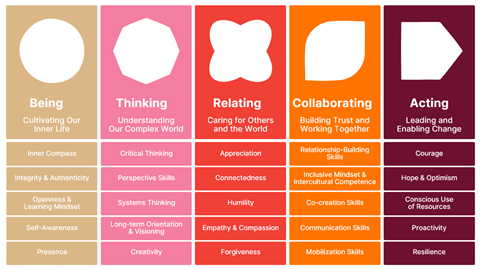
How were these capacities fostered in the companies I studied? Aspects of inner development were present, though mostly implicit and rarely embedded systematically. They showed up in workshops that encouraged reflection, in opportunities to learn through experience and wherever dialogue and participation were possible. Examples included a day off each year for social volunteering, coaching for managers and workshops on personality and strengths. One company also made a point of giving employees as much responsibility and decision-making latitude as possible.
The data suggest that the companies are already creating conditions in which inner development can take place, without thinking of it in those terms. Whether these conditions actually strengthen any capacities, and if so which ones, was not examined.
Does it make a difference what we call it? I think it does. Naming something makes it visible. Once it’s visible, we can talk about it, deliberately foster it and build it into our plans, rather than hoping it will happen by itself. After all, sustainability isn’t only about changing what organizations do. It is also about developing our capacity to actually shape that change.
For internal communication, this means it can create opportunities for people to draw on and practice these capacities, rather than just explaining things. One possible approach, for example, is a format in which employees work together to critically analyze a conflict of goals: asking questions, exchanging perspectives and looking for solutions. That could make more of a difference than a third newsletter on the subject.

What follows from this
Research and practical experience point to a simple test that any company can try. Where, in the past few weeks, have colleagues seen sustainability actually influence a decision? If the answer is “in communication” rather than “in product development, purchasing or sales,” the task may lie less in the messages than in what happens around them.
For me, one thing above all follows from this: internal communication needs clear responsibilities and a long-term perspective, and it should be measured by what it achieves in everyday work, not by its reach. That isn’t statistically proven. But it can be tried out all the same, starting tomorrow.
And there is one question we as an industry should keep asking ourselves: How credible are we on the inside compared with the outside? An industry that draws its credibility from its connection to nature has good reason to live up to it in the team on a Monday morning, too.

About the author
Julia Pröll is a brand marketing and communications professional with more than 15 years’ experience in the outdoor, sports and lifestyle industries. She led marketing for Central Europe at The North Face and O’Neill and has worked with brands including Norrøna, Salewa, Kari Traa and Restube. Alongside her work, she recently completed an MBA in Sustainability Management. For her thesis, she explored how internal communication can help European outdoor companies put sustainability into practice.