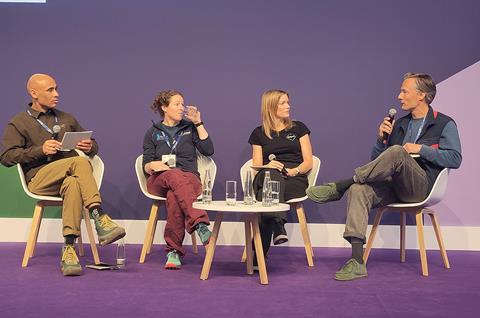
The very first presentation of the Sustainability Stage at ISPO 2025 in Munich on Sunday morning demonstrated why it is so important to have a gathering for the whole industry. In what might have been described as the nightmare slot in the presentation program, what was delivered was a masterclass in why working in collaboration is better for everyone. Many times, before the expression “making the pie bigger for all to eat from” was used, it was more about defending our food as regulations threatened to ban it.
The panel was chaired by Ohana Public Affairs’ Pascale Moreau with an NGO (EOG’s Katy Stevens), an ingredient supplier (Gore-Tex’s Marie Måwe) and a brand (Ortovox’s Luisa Zeeh) and was based around the incoming legislation associated with the EU Green Deal. The message that came out was one that I had heard many times before, but the starkness of it (and actually the simple actions to follow) was that if you do not feed into the consultation process, then you have no right to complain if the regulations that come out do not work in your favor.

Regulations are put together by people in Brussels who are specialists in writing legislation, but they do not know the details of the sports and outdoor industries. If you are happy for us all to be grouped with general fashion and textiles, then the lobbying from the latter segments will be applied to us (because those bodies are getting their audience to join in the process). I might be presuming the latter, but when these are multi-billion Euro companies, I know they will have departments stepping up to this role. One of the slides used on the subject showed that the apparel market was 2 percent large companies, 9 percent SMEs and the rest micro businesses.
If you are not a specialist in what to do, then the best advice was on offer. This was confirmed in the second session on Day 1, which Pascale hosted on People and Planet, so it had Margo de Lange from IGOT, Gillian Rosh from POW Europe and Dan Yates from EOCA, who delved into the subject, which highlighted the difference between advocacy and lobbying (so was able to bring out when to use each channel to maximum effect). Essentially, it was to follow the guidelines issued by these NGOs. All those on stage were wonderfully aligned and demarcated to allow best practice to be easy to zoom into, right down to either only having to add your company brand to the letter being sent, or the details to include that will gain the most impact if you are sending a letter separately. It is very hard to argue against being a signed-up member of the trade association, but the collective effort really was known to be the most powerful lobbying.
Other presentations brought home to multitude of the alphabet soup of regulations, but there are four essential categories for them: the still current ones (like EcoDesign for Sustainable Product Regulation and DPP), the simplified ones (CSRD / CSDDD / Green Claims), the new ones (Environmental Omnibus and Chemical Omnibus), as well as the upcoming ones (Green Deal procurement / Textile Labelling / PFAS restrictions / REACh revision) that ably demonstrated how so much work towards better has been put on hold whilst the compliance is being met. Another factor to consider is that the legislation will take effect in 2027. Most brands are now considering what they will do in 28/29. Hence, the incoming could well throw a spanner in the works of what has already been signed off.
If you only concentrate on two areas, then the EcoDesign for Sustainable Product Regulation, which has durability at its heart, then a keenness towards recycled content and as an add-on: having the ability to recycle the product at end-of-life; plus, what will be added to the product’s environmental footprint that is trying to incorporate a microfiber shedding scale.
The incoming legislation also has the ability to give the sports and outdoor industries the strategic advantage toward better that it deserves for all the iterations of how to create best practice. This is to say that the regulation is a motivation towards the same objective, but if the depth of excellence already created is to be appreciated, then it is known that a scale based more on the breadth of textiles will not champion what we have already invested in cleaning up our own work. These regulations could help ensure that the investment many brands have already made stands out further as homes to good practice. With the incoming Gen Z purchasers saying that they do care about these bigger issues, the signs are positive.
The other stage session that enabled clearer vision was that by EOCA’s Dan Yates and Above The Cloud’s Fredrik Ekstrom when they spelt out how destructive our species has been for this planet: in just their half century lifetime there had been a 73 percent loss of the wildlife population (the corresponding drop in freshwater’s ecosystem was 85 percent) with four out of every five of us acknowledging that it will end in environmental disaster. Green Fatigue had transformed into Future Fatigue as almost 9 out of 10 of us believe that no matter what they do, their individual actions are pointless. The consumer (recorded at 90 percent) feels that brands should openly support and act on these concerns, with the majority of those responding saying that it will ensure their own loyalty to these marques. As current purchasers are just a small active percentage of the market, there is much room for brands to continue to demonstrate their ethics in what they do, that will become the trump card for the future purchasing decisions.
Fredrik captured it in the single word of “Killgissa” – the act of an authority guessing towards an answer. The world has moved on from this status – we (unfortunately) know it now! What was suspected has now been costed (the funding gap to reverse this action is $77 billion in Europe alone) to get business back on the side of nature.
This opened the subject of finance, which echoed throughout ISPO. Nike estimated that the rise in tariffs was costing it $1 billion this year. This was a clear financial statement that drew attention to the changes that have already happened. If brands do not join in the consultation process for the new responsible business legislation, the effect will be as powerful.
Another panel that developed these conversations featured Mid-Sweden University’s Judith Waller, whose work (helped by the Gore donation) started with waterproof garments that had fallen out of use. It so summed up the aspect of the industry in that its primary concern was to produce more items to put onto the market to replace the failing items, rather than starting with those failed items and designing out the problem. The takeaway was that the more complicated we make a garment, the more that can go wrong, which was only confirmed by the United Repair Centre’s Paul Kerssens.
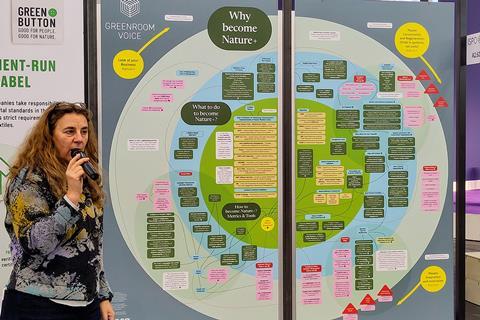
The stage at the Sustainability Area just delivered quality session after quality session. GreenroomVoice had initiated this area 16 years ago, and that it remained busy throughout the show was a testament to how visionary that thinking had been.
Wandering around the other halls was disappointing, especially if you had little interest in paddle – but only because the amount of effort that had been put in had not been matched by the enthusiasm of the visitors. It would have been better to gloss over the outstanding Awards section, which was just compounded by the number of no-shows in the prize-giving ceremony. Hall B1 had a great start-up area (although it did rather make the statement that for a Gen Z company, doing something physical as opposed to a new software program would make them stand out). Brands like Hybex, Boob Protect, TwistBoxes, Packa by MRS, Colorifix, GNL footwear and Graphene-X were all worthy of being taken further. Perhaps it was because those on the GRV tour emitted messages from established brands that were refocusing their efforts to better align with their business direction that provided current tools that matched the future interest areas.
The greatest thing I picked up was a candid document from Gore-Tex that made progress towards the heart of garment durability. The best conversation was brought together by the Mandel’s Matthias Assmann who was able to just subtly up the level of thinking in an open session with journalists like Julien Bels, Christian Milbo and Stefan Brunner alongside a brand (thank you Reo-Eco) as well as the Textile Exchange’s Sophie Ridler and Anna Bernstein which reminded the group that The Purpose Of Purpose Is Purpose.
Munich also attracted other events. Seeing the pop-up shop in town reminded me of the original mantra of ISPO – to demonstrate how to create buzz in retail. Shopping works best when it is an experience. The From Concrete to Gravel site championed this, so finding out that one of the primary sponsors was ISPO Munich just confused me. Oberalp had brought their concept into the halls; the Zeitgeist area was buzzing in the first hall, whilst Highsnobiety was standing room only. ISPO had quality in its halls – that made me think about why they weren’t successful with it.
Amsterdam in early November 2026 is something I am looking forward to, as it has been a brave company to take on the challenge of putting the buzz back into ISPO. The industry needs it. The question will be around whether it will be financially successful.
I have three take-aways from this last staging of the world’s largest sports fair in Munich: the evidence that we all want to meet-up was so obvious; the future is better alignment and cooperation to make the task of bringing the customer with us is key; plus, how can a show for the fabric nerds of the world now be the biggest event left for the sports industry in the main city of Bavaria?